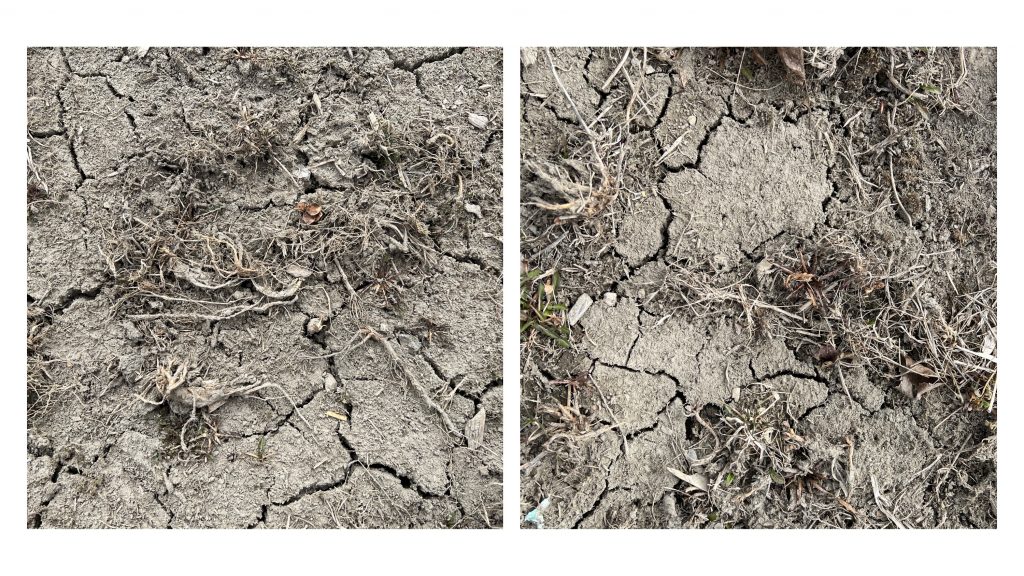
This post was first published in 2024 as a reflection on the ongoing drought experienced in Western Canada. It was initially inspired by photos I took at the Maple Hill Urban Farm in April 2024 (Figure 1). We allotment folks have to haul our own water. I regularly hauled 20 or so gallons on a weekly basis and still it never seemed to be enough. So in 2024 I decided to practice “dry agriculture.” After I got my my seeds germinated and everything well mulched, I would just let mother nature provide the water in the form of rain. Depending on your point of view, 2024 was either a good or a bad year for the experiment because it turned out to be a very wet season. It was so wet, many of my potatoes rotted in the ground.
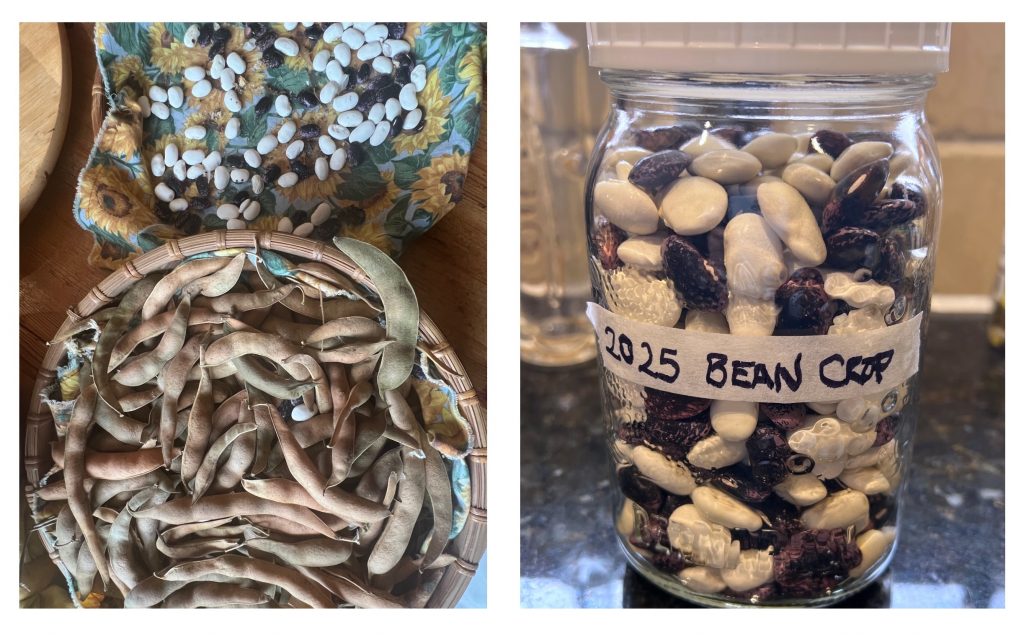
2025 was the exact opposite. Following a wet spring, Ottawa experienced significant drought conditions from June to mid October 2025, with serious impacts on crops and water supplies. I went back to hauling water. By late September, parts of Eastern Ontario, including Ottawa, were under Extreme Drought (D3) conditiona. Despite rather summery conditions, we had a dip in sudden dip temperature around September 20th. A light frost is not usually a problem because humidity will freeze outside the leaves, which can protect the plant. But because we were in a drought with extrewmely low humidity, the cold temperatures froze the water within the plant cells causing what is known as a dry frost, resulting in extensive crop damage at Maple Hill and beyond. The bean leaves all shrivelle below two feet. I hoped my unriped beans would still be able to mature. But no — I had my worst bean harvest in my four years at the farm — one litre jar of my corona and scarlet runner beans together (Figure 2).
About My Artist Book Series
DROUGHT transcribes the drought-diminished landscape in Alberta Canada in the summer of 2024 as felt by me. Each of the five artist books plus one artist proof (Figure 3), contains ten unique collagraph prints mounted in an “explosion book” format (Figure 4) on acid-free cotton rag paper with covers made of handmade paste paper. Each book is roughly 10 centimetres square, expanding to approximately 30 X 60 cm.


I made these six books in June and July in 2024. Sensitized by my research into dry agricultural practices, I was responding emotionally to a newspaper article I read called “Beyond a Reasonable Drought” by Tyler Dawson, Ottawa Citizen, June 1, 2024 (Figure 5). The article was illustrated with lovely images and was an easy read. BUT I found myself amazed by what was not said in the four-page spread.

The article describes the situation in much of Alberta this summer suffering under multi-year drought conditions. Dawson starts his article by saying “It is not a new dry spell out west. It’s been going on for years already, and could end up being worse than we saw in the 1920s, 1930s.” Drought in the prairies brings to mind the dust bowl, the depression and the hardships faced by displaced farmers and farm workers as depicted in the heart-wrenching photographs by Dorothea Lange and Steinbeck’s Grapes of Wrath. In Canada the depression drought lasted from 1929 to 1937 during which time many farms were abandoned. It is widely understood that dustbowl conditions were created by a combination of climactic factors and poor agricultural practices. Afterwards, government jurisdictions introduced new management plans.
According to the Canadian Encyclopaedia, the Prairie region is the most drought-susceptible area in Canada. Written accounts refer to major droughts during the 1800s while paleo-records indicate that droughts, some extending for decades, occurred periodically over millennia. Since settler times agricultural practices have destroyed the natural resilient vegetation and current industrialized agricultural practices, even with irrigation, allow little margin of safety in times of drought.
Low annual precipitation is why the natural vegetation of the region is/ was grasses with dense root structures extending deep underground, as illustrated in Figure 6. These prairie grassland ecosystems have been in place for 10,000 years since the last glacial retreat.

In an interview, Trevor Herriot, author of a number of books about the Canadian Prairies, describes the prairie grasslands as “the most endangered and least protected” of ecosystems with 80-90% of native grasslands already lost throughout Canada’s three prairie provinces (Sims, 112-13). This tragic loss can be attributed to two factors. First 75% of the land is privately owned or privately managed and can be stripped away for agricultural use at any time. The second is that the loss of grassland is less visually dramatic than forest ecosystem yet prairie ecosystems are harder to restore than forests. Because monocrop grain fields or pasture landscapes appear similar to prairie grasslands efforts to conserve may be less fervent.
It is generally acknowledged that climate change, with warming temperatures and climatic disruptions, can be expected to exacerbate extreme weather, including drought and desertification. In his newspaper article, Dawson fails to mention that climate change might be a contributing factor to higher temperatures and more erratic precipitation patters that are exacerbating drought conditions. Nor is there mention that drought-stricken Alberta is home of the Tar Sands and the heart of the Canadian petroleum industry, both major contributors to Canada’s high carbon emissions and a root contributor to global climate change.
In The Climate Book, Greta Thunberg expresses her belief that politicians and the press are failing to communicate the seriousness of the crisis, and that media are not performing their traditional role to hold politicians to account. Instead, she says “media has allowed the people in power to create a gigantic greenwashing machine designed to maintains business as usual.” (Thunberg, section 5.8). George Monbiot goes further in stating that media is the “industry … most responsible for the destruction of life on Earth” by denigrating climate change activists and diminishing the sense of urgency for climate action (Thuneberg, 5.11). This failure to be part of the solution is no doubt the result of a consolidation of newspapers and other media in the portfolios of wealthy capitalists. I conclude that Tyler Dawson’s “Beyond a Reasonable Drought” is an example of this failure to communicate the human factors of drought so not to ruffle any corporate or cultural feathers.
References:
Dawson, Tyler. “Beyond a Reasonable Drought”, Ottawa Citizen, 01 June 2024.
Hill, H. “Drought”. The Canadian Encyclopedia, 04 March 2015, Historica Canada. www.thecanadianencyclopedia.ca/en/article/drought. Accessed 11 July 2024.
Sims, Jessica. “Q&A with Trevor Herriot, Author of The Economy of Sparrows,” Trail & Landscape Vol 58, No.2, Apr-June 2024, 110-116.
Thunberg, Greta. The Climate Book (e-book version), Penguin Press, 2023.
Reddit Image source: https://www.reddit.com/r/alberta/comments/mdpfvd/prairie_grass_roots_vs_agriculture_roots/